Tracking the information about your manuscript
Communicate with the editorial office
Query manuscript payment status Edit officeCollecting, editing, reviewing and other affairs offices
Managing manuscripts
Managing author information and external review Expert Information Expert officeOnline Review
Online Communication with the Editorial Department
Page Views
Information
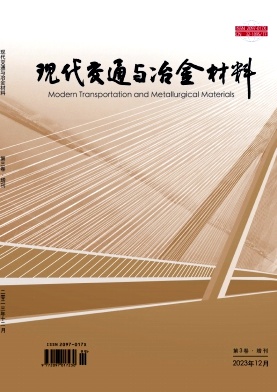
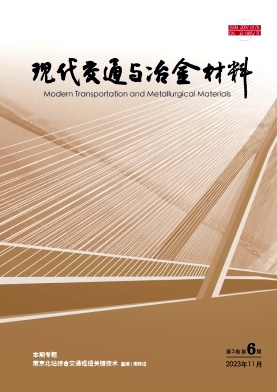
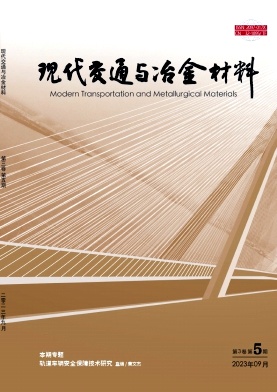
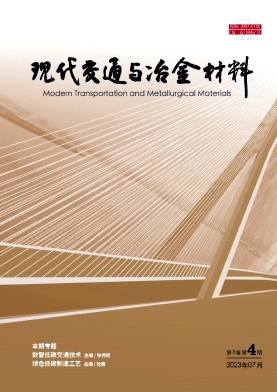
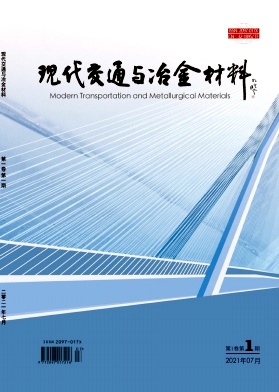
 Journal Title: Modern Transportation and Metallurgical Materials
Established: July 2021
Governing Authority: Jiangsu Association for Science and Technology
Sponsors: Jiangsu Provincial Comprehensive Transportation Society and Jiangsu Metal Society
Publication Frequency: Bimonthly
Tel: 025-58783287
Email: xdjtyyjcl@163.com
CN 32-1895/TF
ISSN 2097-017X
From localized intelligence to systemic intelligence: strategy and governance architecture for building a large‑scale AI traffic model system for China' s expressways
WENG Mengyong;RAN Bin;TAN Xianfeng;LIANG Hua;XU Zhibin;ZHANG Hongjun;JING Peng;QU Xu;RUI Yikang;SUN Hucheng;WANG YuanAt present, generative artificial intelligence (AI) represented by foundation models is driving a profound transformation in transportation cognition and governance paradigms. As the world's largest large-scale and complex transportation system, China's expressway network can no longer be effectively managed through traditional approaches that rely on localized perception and decentralized decision-making. Meanwhile, the development of transportation foundation models across different regions has shown a fragmented pattern in the absence of a unified top-level framework, posing the risk of creating new “intelligent islands.” This paper argues that China's transportation intelligence development urgently requires a paradigm shift from local intelligence to system intelligence. Based on this perspective, the study systematically elaborates on the strategic urgency, top-level architecture, and implementation pathways for building a nationally unified and coordinated AI foundation model system for transportation. In terms of system design, an integrated closed-loop paradigm of perception –cognition-decision-making-execution is proposed as the core framework, supported by a two-level organizational structure of national coordination and provincial implementation, and a layered capability ecosystem characterized by foundation models for cognition and lightweight models for execution. In terms of practical implementation, the paper further proposes three key pathways, that is, establishing institutional foundations through standards-first governance, driving value realization through scenariooriented applications, and fostering innovation through collaborative ecosystem development. This study aims to provide theoretical guidance for the modernization of China's transportation governance capacity and offer policy references for the implementation of the national strategy of building a transportation powerhouse.
Special Topic Introduction
WANG HaoIntelligent innovation and policy orientation for expressway capacity expansion
DING Fan;YANG Yang;LIU Zhao;DAI Yunqi; WANG HaoGuided by national strategies such as the Transportation Powerhouse Strategy and Digital China, China's expressways are undergoing a transition from traditional physical capacity expansion toward intelligent capacity expansion. Intelligent capacity expansion mainly relies on new-generation information technologies, including big data, artificial intelligence, vehicle-road collaboration, and vehicle-road-cloud integration, to optimize traffic organization and operational control, thereby unlocking the latent capacity of existing infrastructure while ensuring traffic safety. Based on a keyword-based analysis of recent policy hotspots and literature in China's expressway sector, this paper reviews the current development of intelligent capacity expansion at both national and local government levels, and clarifies specific policy orientations and their underlying logical relationships. Furthermore, in light of the “Artificial Intelligence+Transportation” action plan, this paper analyzes and discusses potential directions for the next stage of intelligent development in the expressway sector.
Research on hierarchical and categorical assessment method for demand of expressway capacity expansion
TAO Wei; LIU Yanping;ZHOU Jie;WANG Yi;XU YueruWith the continuous growth of expressway traffic volume and diversified structures of travel demand, traditional decision-making methods for capacity expansion fail to meet the requirements of refined traffic management. Against the background of expressway construction, this paper proposes a hierarchical and classification analytical framework for capacity expansion demand evaluation. Starting from core traffic indicators including traffic flow, vehicle speed, traffic density and peak-hour characteristics, Principal Component Analysis (PCA) is adopted to extract key factors representing segmentlevel expansion pressure, which eliminates multicollinearity interference among multiple indicators.The K-Means clustering algorithm is further applied to conduct horizontal categorization of road segments, dividing expressway sections into three types: capacity-oriented segments, uneven-flow segments, and segments with no expansion demand. This classification reveals the disparities among road segments in terms of traffic load and peak concentration characteristics. Combined with the Analytic Hierarchy Process (AHP), a vertical hierarchical grading system is constructed from two dimensions:traffic capacity and flow distribution. Comprehensive evaluation scores are quantitatively calculated,and four expansion demand grades (low, medium-low, medium-high, high) are determined via the quantile method.Empirical verification results demonstrate that the proposed framework can effectively identify road segments with high expansion priority and provide scientific support for resource allocation and traffic governance strategies. Compared with conventional expansion judgment approaches relying on single indicators, the hierarchical classification framework developed in this study can comprehensively reflect the operational pressure and potential bottleneck features of expressways, offering novel insights for expressway planning, capacity expansion and operational management.
Research on expressway anomaly event detection methods based on multimodal large models
LIU Huaxue;ZHOU Jie; CUI Liang;MO Hongyun;LU Ruyang;YAN YufengA key challenge in expressway anomaly handling is that existing methods usually identify local abnormalities from a single sensing signal, but struggle to jointly determine event type, cause, and risk. To address this issue, this paper proposes a multimodal large-model-based method for expressway anomaly event detection. This paper addresses the demand for intelligent expressway management by proposing a multimodal large-model-based anomaly detection method. It integrates heterogeneous data from multiple sources, including video surveillance, millimeter-wave radar, traffic flow, and me‑teorological information, through a “modality expansion-scenario fine-tuning-cross-modal attention Transformer fusion”approach. This process maps diverse features into the CLIP shared semantic space, enabling unified representation of heterogeneous data. Combining traffic knowledge graphs with prompt engineering guides the large model to deeply analyze the types, causes, and potential risks of abnormal events. Experimental results based on the DAIR-V2X dataset demonstrate that the proposed method significantly outperforms traditional approaches in both detection accuracy and comprehensive semantic understanding. This provides a new technical pathway and theoretical foundation for multidimensional perception on expressways.

News
Bridging with the Journal, Gathering Wisdom Through Conferences The Modern Transportation and Metallurgical Materials Platform Empowers the Academic Report Meeting of the Society Consortium of the Jiangsu Association for Science and Technology
2026-08-19The first meeting of the second editorial board of "Modern Transportation and Metallurgical Materials" was held
2026-08-19The Provincial Promotion Meeting for Integrated and Innovative Development of Metallurgical Materials and Transportation Industry, as well as the First Meeting of the Second Council of "Modern Transportation and Metallurgical Materials", was held in Nanjing
more..